Blue whale
Balaenoptera musculus
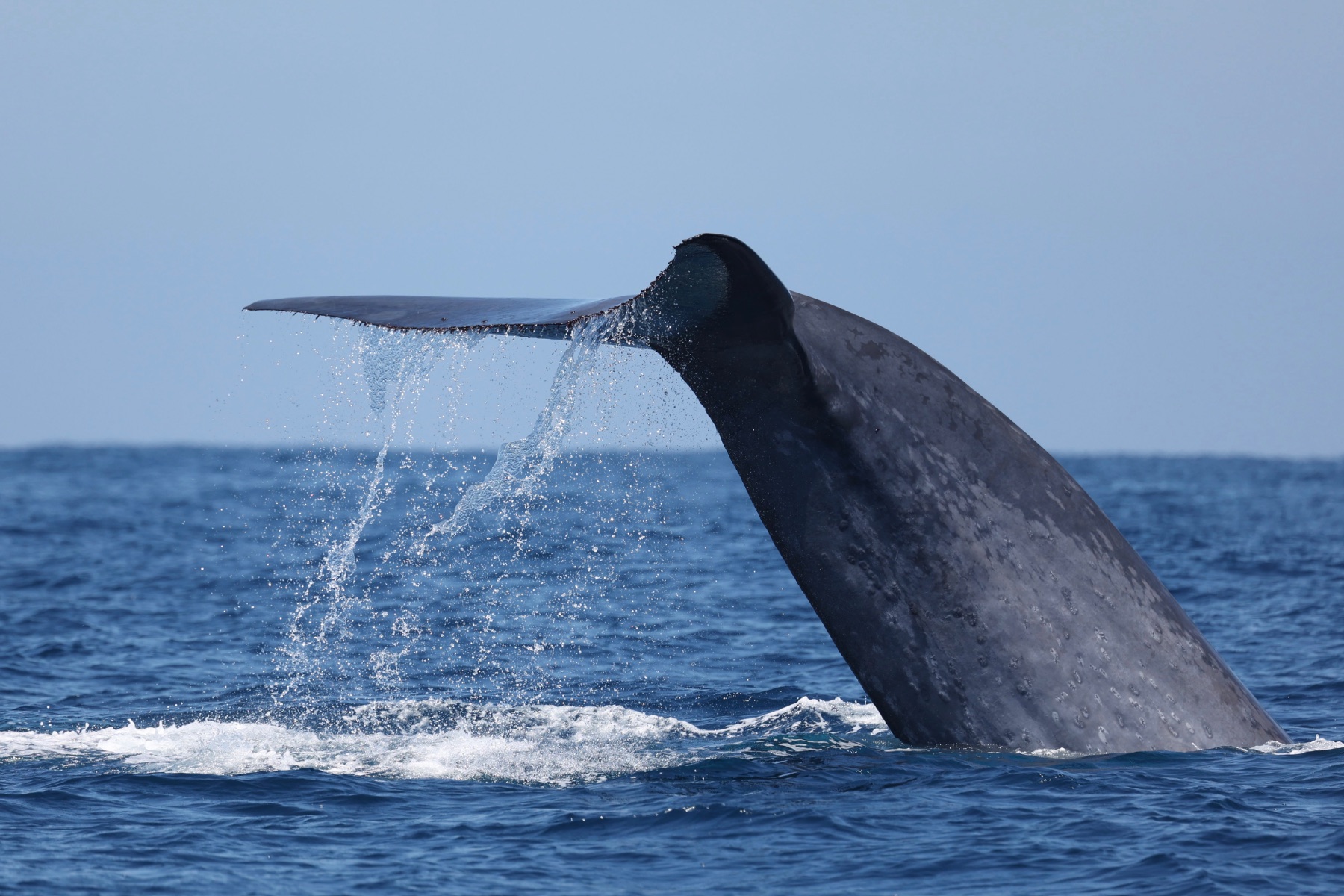
At up to 110 feet and 165 tons, blue whales are — in NOAA's words — the largest animals ever to live on our planet. The Santa Barbara Channel provides summer feeding habitat when dense krill aggregations develop — watch for a flat, oily "fluke print" before the animal sounds.
About 2.5× as long as a school bus, nose to tail.
A blue whale runs about 100 ft. Lined up against a school bus everyone already has a mental ruler for, each one 39.3 ft per the manufacturer's own spec sheet.
School bus: 39.3 ft (472 in), Blue Bird Vision 72-passenger conventional bus, manufacturer spec sheet.
Drawn to the same scale. 100 ÷ 39.3 ≈ 2.5.
In a decade of quarterly surveys across the Southern California Bight, blue whales were recorded in summer roughly 40x more often than in winter or spring — 62 of 79 sightings fell in summer. A blue whale in August is the expected outcome, not a fluke. The eastern North Pacific population is about 2,000 animals, modelled at 97% of carrying capacity in 2013, and it feeds off California, one of a small number of places on earth where blue whales are reliably encountered.NOAA Blue Whale ENP stock assessment, rev. 5/14/2024 source →
Eastern North Pacific population, modelled at 97% of carrying capacity in 2013 — about 2,000 animals.
At a glance
Length/weight/lifespan/diet: NOAA Fisheries species page →
In a decade of quarterly surveys across the Southern California Bight, blue whales were recorded in summer roughly 40x more often than in winter or spring — 62 of 79 sightings fell in summer. A blue whale in August is the expected outcome, not a fluke. The eastern North Pacific population is about 2,000 animals, modelled at 97% of carrying capacity in 2013, and it feeds off California, one of a small number of places on earth where blue whales are reliably encountered.
NOAA Blue Whale ENP stock assessment, rev. 5/14/2024 source →
HOW RARITY IS JUDGED →What to look for
Best months to see
Last 30 days
This chart includes numerical reports only. Uncounted sightings do not appear in its totals; see the daily archive for presence reports.
Where to go (operators publish dated sighting reports)
We monitor public trip reports across Newport Beach, Long Beach, Dana Point and San Diego. Reporting schedules vary; summaries show the latest available report. Newport's shared feed is counted once.